

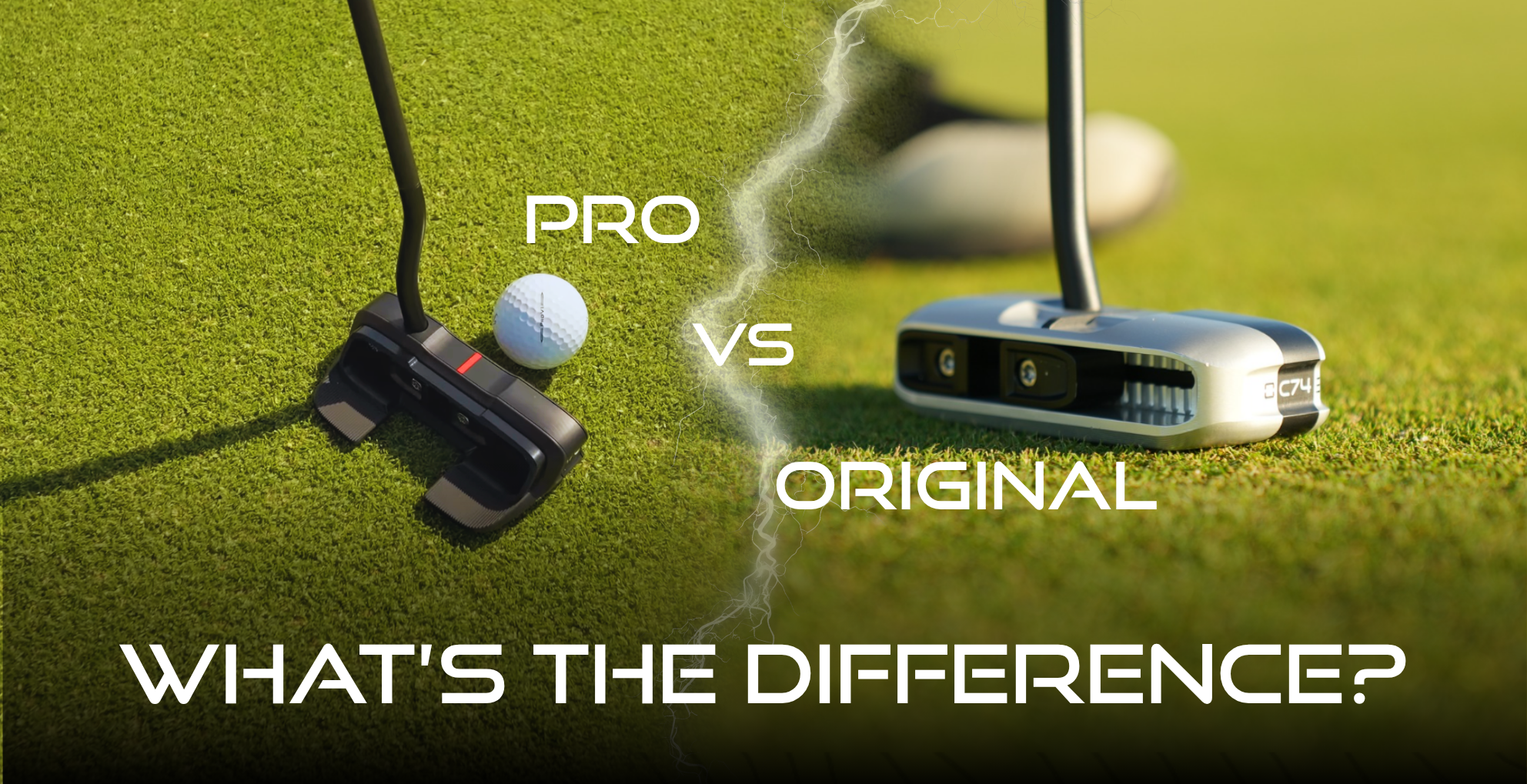
Both ranges use the same fitting system, the same SMART Assembly architecture, and the same modular logic.
The difference is in the materials and who they're built for.
Here's what separates them across the four things that matter most.
Visual Design
Original —
The larger of the two ranges. Available in three head shapes: Original, Blade, and Mallet. Each carries the 3D Aiming Sight, a raised alignment feature on the crown that helps you align your club face at address. If you've ever stood over a putt uncertain whether the face is square, that's what it solves.
Pro —
Thinner profile, more compact head, no 3D aiming sight. For golfers who find alignment aids distracting, or who simply prefer the look of a tour-spec putter, the Pro's aesthetic is closer to what you see on Tour. Available as Pro Blade or Pro Mallet.
The call:
Visual help at address → Original.
Minimal, clean look → Pro.
Feel
Original —
The 2026 X-Face puts a stainless steel core inside an aluminum body. Impact is soft-to-medium: enough cushion to take the harshness out of a firm strike, enough feedback to tell you whether you caught the center.
Pro —
Full SS304 milled stainless steel throughout. The feedback is immediate and direct. Miss the center and you'll know. That's not a flaw — for a golfer precise enough to use that information, it makes the putter more useful. The Pro doesn't soften the information. It delivers it.
The call:
Softer, forgiving feel → Original.
Firm, tour-level feedback → Pro.
Weight
Both ranges adjust weight through the same back rail system. Sliding weights change where the center of gravity sits — affecting how the face rotates through impact and how the putter feels in the hands.
Original weights: 18g, 30g, 48g. Larger increments. Each shift produces a noticeable change in balance and feel — easy to identify, easy to work with for the majority of golfers.
Pro weights: 5g, 15g, 30g. Smaller increments. The difference between 5g and 15g is subtle. That's the point. For a low-handicap golfer who has spent years learning to feel their putter, that granularity matters. For most golfers, it would be unnoticeable.
The call:
Noticeable, meaningful adjustments → Original.
Millimetre-level fine-tuning → Pro.
Forgiveness
Original —
Larger head, wider weight distribution, designed to minimise the penalty for off-centre contact. A miss toward the heel or toe still rolls reasonably well. Suited to golfers whose contact isn't yet fully consistent.
Pro —
Smaller head, less margin off-centre. The Pro was built for golfers who consistently contact the sweetspot. It rewards that precision with cleaner feedback and more responsive roll. Miss it and the Pro will make sure you noticed.
The call:
Low-to-high handicap, developing your stroke, made for all players → Original.
Competitive amateur, consistent ball-striker → Pro.
Which One Is Yours?
| Original | Pro | |
|---|---|---|
| Visual design | Larger head, 3D Aiming Sight | Compact, clean topline |
| Feel | Soft-to-medium, X-Face | Firm, direct, SS304 |
| Weight system | 18g / 30g / 48g | 5g / 15g / 30g |
| Forgiveness | High | Low by design |
| Best for | All golfers, mid-to-high HCP | Competitive, low HCP |
| Price | €400–500 | €600–700 |
Both are built to match your stroke, not the other way around. The Original gives you more margin. The Pro gives you more feedback.
Partager:
RUNNER × (RED) : Quand le putting dépasse la performance