

Golfers spend hours fine-tuning drivers for swing speed and fitting irons for launch and spin. The putter, the single club responsible for nearly 40% of every score, is more often bought off the wall after a quick roll on a shop carpet.
Feel matters when choosing a putter, but start-line accuracy comes down to measurable physics: on a putt, the face angle at impact governs roughly 80 to 85% of the direction the ball starts. That is the variable a fitting works on.
So is a putter fitting worth it?
For most golfers the answer is yes, because a fitting changes measurable inputs (lie, loft, length, and weighting) and, with them, the confidence that comes from a putter that behaves the same way every time.
This guide explains what a fitting checks, what it changes, and how to tell whether it made a difference.
Why the putter is the club most worth fitting
The logic is simple arithmetic.
Putting accounts for close to 40% of the strokes in an average round, yet it is the club golfers most often leave to chance.
Irons get fitted for launch, the driver for swing speed, wedges for bounce.
The putter tends to be chosen for how it looks behind the ball and how it feels to pick up, neither of which reveals whether it aims where the golfer is aiming or suits how they actually move.
The old adage, drive for show and putt for dough, points at the same idea.
The putter is the highest-leverage club in the bag and the one most commonly left unfitted. A fitting closes that gap.
What 'worth it' means for a putter
A fitting is worth it when it changes something measurable, not just a feeling. The clearest metric in putting is face angle at impact, because it governs the majority of start-line direction.
The scale is what makes it matter. Roughly one degree of face angle off at impact is enough to miss a straight nine-foot putt, a distance most amateurs face several times a round. Errors that small are impossible to feel in the hands, which is why golfers often blame a misread or bad luck for a start-line problem that was really equipment. A fitting is worth it when it removes those hidden errors from the setup.
What a putter fitting checks and changes
A good putter fitting is a diagnosis rather than a sales conversation. It works through the variables in roughly this order:
- Lie angle. How the sole sits at address. If the toe sits up the face aims left, and if the heel sits up it aims right, so the ball starts offline even on a good stroke. Lie is the most common unfitted variable in putting, and a repeating directional miss is usually a lie issue until proven otherwise.
- Length. Set by posture, not height. Too long and the golfer crowds themselves and tends to pull; too short and they reach and tend to push.
- Loft. The loft actually delivered at impact, once forward press and shaft lean are accounted for. Correct loft lifts the ball out of its resting depression and gets it rolling on line sooner.
- Weight and centre of gravity. The variable most often overlooked. Repositioning the weight in a putter's back rail moves the centre of gravity, which changes how the face rotates through impact. The same stroke, on the same head, can deliver a different face angle depending on where that weight sits.
- Shape. A very personal variable that isn't measured in a quantifiable manner. A shape that corresponds to the look that the player wants to see provides increased confidence but also comfort in aligning the putter.
None of these change the golfer's stroke. They set the equipment to the stroke the golfer already has.
What impact data shows a fitting can change
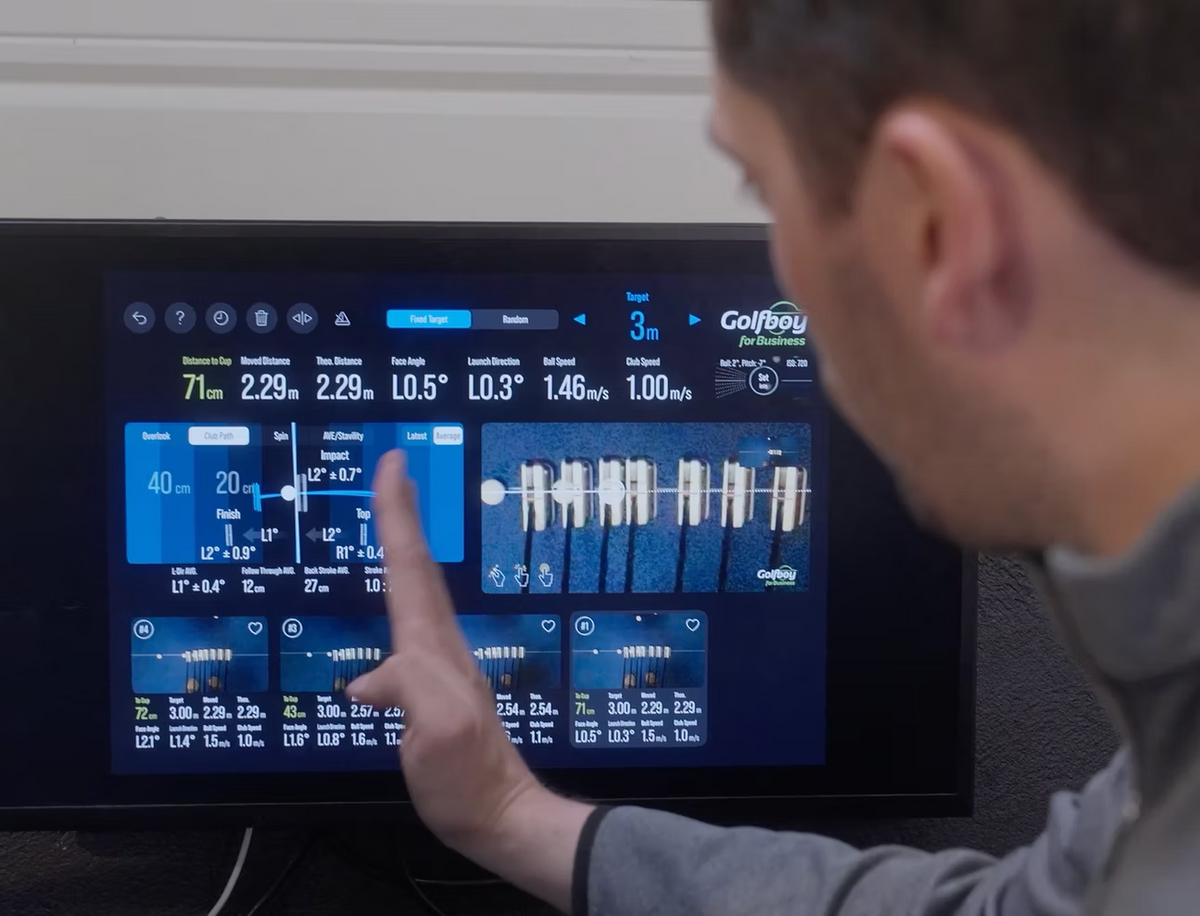
Launch-monitor data illustrates the effect clearly. A golfer who consistently starts putts to the right usually has a face that sits open at impact. Adjusting lie, loft, and weighting can bring that face angle meaningfully closer to square without any change to the stroke, for example from around 2 degrees open (Right) to roughly 0.7 degrees open. On a monitor, the difference is visible in the numbers captured before and after.
A correction of more than a degree is significant, because it is larger than the margin that separates a made putt from a lip-out on a short putt. It is also the kind of change that is realistically repeatable, rather than a one-off perfect strike.
Independent testing offers an outside reference point too: MyGolfSpy named Runner a Most Wanted Putter for 2025 in both the blade and mallet categories.
The useful part for a golfer, though, is not the award. It is that the improvement shows up as a number that can be measured and repeated.
Is a putter fitting worth it for a high handicapper?
Often more than for a low handicapper. When a putter aims or releases in a way that does not match the golfer, practice tends to groove a compensation alongside the skill, so the player becomes good at correcting an error they should not have to correct.
Practice remains essential. The point of a fitting is to make sure those repetitions build on a clean foundation instead of teaching the hands to rescue a putter that points somewhere the golfer never intended. Lower handicaps benefit because the last fraction of a degree affects scoring; higher handicaps benefit because the setup often hides larger, very fixable misses.
What a putter fitting costs, in time and money
Fitting fees vary by retailer, and many apply the fee toward the putter if the golfer buys one. Runner offers two formats:
- Easy AI Fitting, about 15 minutes. The golfer answers a short quiz while the display's camera reads setup posture and stroke path. An algorithm then recommends a configuration and weight settings. It runs online and needs no specialist.
- Expert Fitting, about 30 minutes. A trained fitter captures the stroke on a launch monitor, builds the recommended configuration from more than 2,600 options, then re-measures and fine-tunes the weighting against live face-angle data.
Both end in the same place: a putter set up for how the golfer actually moves. In practical terms it is the same attention to lie, loft, length, and weighting that serious players give their equipment, made accessible to any golfer in about the time it takes to warm up.
So, is it worth it?
A putter fitting does not replace practice or a good read.
What it does is make sure the club used on nearly 40% of shots is not adding a miss of its own, and it produces a putter the golfer can trust. That trust is where comfort over the ball comes from. For most golfers, the combination of a measurable improvement in start-line accuracy and the confidence that follows makes the time worthwhile.
A short at-home questionnaire is a low-commitment way to see where a current putter may be working against a stroke, since it reads setup and stroke inputs and suggests a configuration from there.
FAQ
How much does a putter fitting cost?
It varies by fitter and format. Some stores will go into more detail than others, but it does not mean it will be more expensive.
The price of the fitting may be waived in some stores if you purchase the putter. Most of the time it may go from 50$ to 200$ for a 1-hour session.
Is a putter fitting worth it for a high handicapper?
Usually yes, and often more than for a low handicapper. A mis-fit putter forces compensations that practice only reinforces, so fitting the equipment first means practice builds a genuine skill rather than a workaround.
What do they measure in a putter fitting?
Lie angle, length, delivered loft, and centre of gravity (which controls face rotation). In a data fitting, a launch monitor also captures face angle at impact, start direction, strike consistency, skid distance, etc.
Can a putter fitting lower my scores?
It can remove start-line errors caused by equipment, such as a face that sits open or closed at impact. It does not read greens or manufacture pace, so it improves the inputs a golfer controls rather than guaranteeing a lower score.
How long does a putter fitting take?
Generally 1 hour in a traditional store or fitting. With Runner, around 15 minutes for an AI fitting and about 30 minutes for a full launch-monitor session.
Share:
Putting Stroke Arc: Straight Back or Arc, Which Are You?